NuCalm, BrainTap and NeuroVIZR prices: what brainwave hardware actually buys you
NuCalm runs $14.99-$49.99 a month, a BrainTap visor is $797 plus $260 a year, a NeuroVIZR pack lists at $599. Here is what that money buys, where the evidence actually sits, and how an EEG-measured approach on your phone compares.
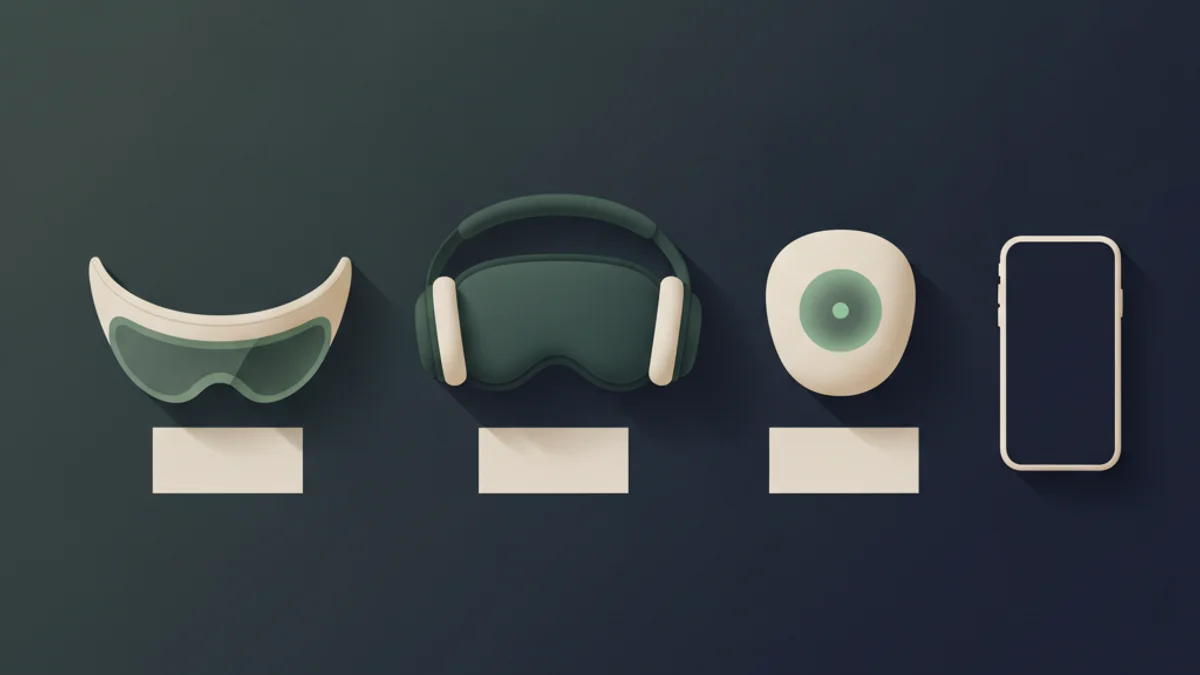
NuCalm requires a monthly payment between $14.99 and $49.99, depending on the plan. The BrainTap visor costs $797, and its app adds $29.99 every month or $260 every year. The NeuroVIZR headset lists at $599, though the price is often around $449, and most of its content library needs a monthly subscription. So what these three products sell is a delivery format (a visor, a headset or an audio membership) plus a catalogue of sessions. The method underneath is rhythmic light and sound that the brain’s own rhythms tend to follow. It is public and has existed for decades. Whether a session does anything depends on how it is designed and whether anyone has measured the results.
The price list, side by side
| Product | What you pay for | Price (October 2026) |
|---|---|---|
| NuCalm | Audio subscription, used with a light-blocking eye mask | $14.99 to $49.99/mo, up to $539.99/yr |
| BrainTap | LED visor plus app subscription | $797 visor, then $29.99/mo or $260/yr |
| NeuroVIZR | LED headset, premium journeys on a monthly plan | $599, sometimes ~$449 |
| 6th Mind | App on your phone: flash, or screen in headset mode | Free app; optional $10-$30 3D-printed headset; optional Premium $5.99/mo |
How you pay matters more than the exact amounts. NuCalm is a continuous subscription that provides no light stimulation at all. BrainTap is a physical device paired with a continuous subscription. NeuroVIZR is a physical device that needs extra payments to unlock most of its content. And if you stop paying for NuCalm or the BrainTap app, the sessions are no longer accessible.
What the hardware actually buys you
For $600 to $800 you get a light source: LEDs mounted in a visor or glasses in front of your eyes. The phone you already own can do the same job.
A modern phone display is bright and refreshes more than a hundred times a second. The phone also has a high-intensity flash and stereo audio, all controlled by a single internal clock. In 6th Mind, the light comes either from the camera flash, through closed eyelids, or from the screen in headset mode. In this mode the phone sits in a basic 3D-printed frame that keeps outside light out. The screen is split in two, so each eye sees one half and the rhythm covers your entire field of vision. Every frequency band has its own colour. Each eye’s half is divided into small cells, and only some of them light up on each pulse, so the pulse stays sharp from 1 Hz up to the display’s maximum rate instead of blurring into a continuous glow. The light pulses and the isochronic tones are generated from the same frequency data and stay aligned frame by frame.
There is also a difference in how the light treats your eyes. Most dedicated audio-visual entrainment hardware uses high-intensity LEDs designed to force light through closed eyelids, which is why those devices are not meant to be used with your eyes open. A phone screen is a gentle, diffuse light source, and you can change its brightness. That makes sessions with open eyes possible: you watch the patterns at a comfortable light level. Short animations, slow spirals and rings turning in opposite directions, help your gaze settle before a session begins. Open-eyes flicker is also how the research is usually done: studies of steady-state visual evoked potentials and the home trials of 40 Hz stimulation both use it.
”Clinically proven” is a marketing phrase
“Clinically proven” has no regulatory definition. The same words can describe a large randomised trial or a small study without a control group. An independent review of NuCalm from August 2026 gives it a score of 5.5 out of 10 and says its promotional materials claim more certainty than the science currently supports. In July 2026, BrainTap announced its NeuralChek Go device, citing “decades of research and 12 clinical studies”, but the announcement included no citations and no description of methods.
What to look for instead: the name of a scientific journal, the number of people in the study, a control group, and an objective measurement of brain activity before and after a session.
Where the evidence actually lives
The published papers test the general method, not specific companies. A June 2026 review in the journal Explore identifies 13 randomised trials of theta binaural beats involving 630 people. Only four of them, with 173 people, have data similar enough to combine for pain, and they show a standardised mean difference of -0.53, which the authors rate as low certainty. A 2026 review in Acta Neuropsychiatrica covers ten trials with about 970 young adults, with effect sizes from d=0.34 to 0.59. Theta shows the clearest effect on physiological markers of stress.
None of these studies tests NuCalm, BrainTap or NeuroVIZR. A higher price tag does not make the evidence for the method any stronger.
How our sessions are built: measured, not assumed
Our sessions come from our practice office in Sofia, where a psychotherapist, with a psychiatrist consulting when needed, runs audio-visual entrainment (AVE) on professional equipment. Two minutes of EEG are recorded before and after every session. Across more than 1000 sessions with 170 people, about 80% of programmes that reached 10 or more sessions (n≈70) improved on our EEG baseline index. Those are people who finished the programme, not everyone. There is no randomised trial yet. Sham controls are hard to design for AVE, and we say so openly.
The office data shaped the app. Each session is a sequence of frequencies rather than one unchanging tone. It starts higher, steps down in roughly thirty-second ramps to the target band (for 40 Hz gamma, it climbs up instead) and stays at the target for most of the session, while the carrier tone is re-tuned as the frequency changes. We chose the sequences, the ramp timings and the carrier tones by comparing before-and-after EEG recordings from the office. The 11-minute format and its 6-minute version come from the same work. A short questionnaire then builds a 15-day personalised programme from the frequency profiles that worked best in the office for people with similar profiles.
What you get here that hardware companies do not offer
- The Session library on the web. All 36 default sessions (alpha for mood, theta for stress, delta for sleep, 40 Hz gamma for focus) play free in your browser in the Session library, with no account and nothing to install. You hear exactly what you will be using before you download anything.
- The Session creator. In the Session creator you build your own session: choose the band and target frequency, a length between 6 and 60 minutes, how long to stay at the target, and your own music or a built-in noise. It is built by the same rules as our catalogue sessions and then appears in the app with the synchronised light. None of the three hardware companies lets you do this.
- Mental 6-packs and routines. Themed sets of six sessions. You can also add a morning 40 Hz mental clarity session and an evening sleep session to your daily programme.
Three questions to ask before you buy
- Is the evidence about the brand or the method? If it is about the method, you are paying a premium for knowledge that is already public.
- What happens when you stop paying? Without the app subscription you lose access to the sessions, and a $797 visor has nothing to play.
- Was anything measured? Ask whether the vendor recorded EEG before and after sessions, how many people took part, and whether it publishes the denominator: how many people the result is based on.
Frequently asked questions
Is NuCalm or BrainTap worth the money? If you need a dedicated device for a practitioner’s office, or you prefer NuCalm’s audio-only format, they are polished products. If you want light and sound entrainment at home, you can do it on the phone you already own without spending anything.
NeuroVIZR vs BrainTap: which is better? NeuroVIZR is a one-off device purchase with a paid library tier. BrainTap is a visor with an ongoing subscription, sold mostly through health practitioners. Neither company publishes randomised evidence specific to its own hardware. Our NeuroVIZR, BrainTap and NuCalm comparisons go into detail.
Can a phone really deliver audio-visual entrainment? Yes. The method only needs light that pulses at a controlled frequency, synchronised with sound. In headset mode the screen fills your entire field of vision, one half for each eye, and the quality improves whenever your phone’s display does.
Can I do sessions with my eyes open? Yes, in 6th Mind’s open-eyes mode. A phone screen gives soft light that you can dim to a comfortable level. The closed-eyes option is still there if you prefer it. You can read more about the method in our AVE explainer.
Do these products treat anxiety or insomnia? None of them, ours included, is a medical treatment. Entrainment is a complementary tool that can help you relax, wind down or fall asleep. Use it alongside professional care, not as a replacement.
Is flickering light safe? For most people, yes. Photosensitive epilepsy is the main contraindication. If that applies to you, turn the light off, use sound only, and talk to a doctor first.
Sources
- “Efficacy of theta binaural beat therapy on pain, cognition and anxiety in adults: a systematic review and meta-analysis of RCTs” - Explore, 2026
- “Music and binaural beat interventions for young adults: a systematic review of effects on anxiety, sleep, and cognition” - Acta Neuropsychiatrica, 2026
- “Flicker regularity is crucial for entrainment of alpha oscillations” - Notbohm, Kurths & Herrmann, Frontiers in Human Neuroscience, 2016
- “A feasibility trial of gamma sensory flicker for patients with prodromal Alzheimer’s disease” - He et al., Alzheimer’s & Dementia (TRCI), 2021
- “NuCalm review” - MedConsumerWatch, 2026
- “NuCalm subscription plans” - NuCalm, 2026
- “Introducing NeuralChek Go” - BrainTap, 2026