
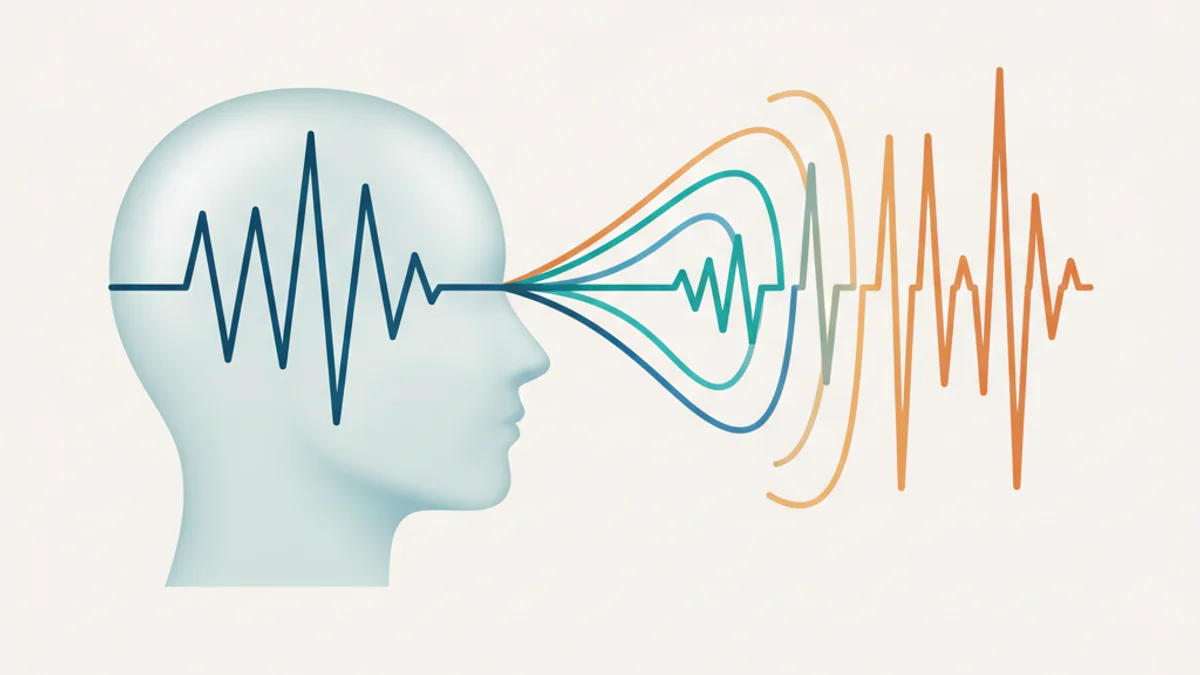
Brainwave entrainment is a general name for a basic concept - when a person provides a constant rhythm to the brain through a pulsing sound or a flickering light, groups of nerve cells often coordinate their electrical pulses to match that rhythm. Binaural beats, isochronic tones, flickering light, audio visual entrainment (AVE) and 40 Hz stimulation are not rival methods. They are various techniques that achieve the same basic result. In this guide there is an explanation of that process, the definitions of the frequency ranges of brain activity and the areas where scientific proof is either robust or limited.
What is the actual definition of “entrainment”?
Entrainment is the process that occurs when a rhythmic external signal causes an internal rhythm to align with it. In the brain the process is the frequency-following response. When a stimulus that repeats enters the senses, groups of nerve cells start to fire at a rate that matches the stimulus. And this coordinated activity is visible on an electroencephalogram (EEG).
To achieve this the signal must be rhythmic - A single flash or a single sound does not create a lasting effect - but a signal that repeats at a stable frequency, like ten pulses every second, provides a pattern for the brain to follow - this is the complete basis of the technique. And the method is supported by EEG studies rather than by spiritual beliefs.
What are the categories of brainwaves and what is their significance?
Scientists group brain activity into frequency ranges - each range is broadly linked to specific conditions of the mind
- Delta (about 0.5-4 Hz) - This is related to deep sleep without dreams and processes that repair the body.
- Theta (about 4-8 Hz) - This is related to feeling sleepy, being very relaxed and processing emotions when a person is close to falling asleep.
- Alpha (about 8-12 Hz) - This is related to a state that is quiet and relaxed but also attentive.
- Beta (about 12-30 Hz) - This is related to active thought and focusing on tasks.
- Gamma (about 40 Hz) - This is related to paying attention and the “binding” of data throughout the brain.
As a necessary caution, it is important to note that those connections are mostly correlational. Researchers observe that specific frequency ranges increase during certain states - but “more theta” is not a guarantee of “more relaxed”. And the act of increasing a frequency range on an EEG is not identical to creating the emotion that people associate with it. When content for entrainment is high in quality, it treats the ranges as helpful indicators rather than as direct controls.
By what methods is entrainment provided?
There are three main ways to provide entrainment and they vary in how much they affect the brain and how reliable they are
- Sound. Binaural beats provide two tones that are slightly different, with one tone in each ear. Because of this the brain perceives a third “beat” at the mathematical difference between the two - those require headphones. Isochronic tones are a single tone that a system turns on and off in a sharp rhythm - those are effective through speakers and usually create a response that is more powerful and more clearly defined. (We cover the trade-offs in detail in binaural beats vs isochronic tones.)
- Light. A light source that flickers influences the visual system directly. And the visual system usually responds to entrainment in a very strong way.
- Combined (AVE). Audio-visual entrainment matches pulsing light with rhythmic sound on the same frequency. By doing this the method uses two sensory paths at the same time. This is the approach behind AVE therapy.
What are the actual effects of brainwave entrainment?
The evidence is most reliable when the claims are very narrow. In a study on home based audio-visual use in the Journal of Neurotherapy, researchers find that a four week program makes the severity of insomnia and the interference of pain lower. Because the participants follow the program closely, it is a sign that doing entrainment many times can change brain patterns over a long period. For thinking skills, 40 Hz gamma stimulation is the method with the most research; our breakdown of how 40 Hz improves memory and focus walks through what that research shows and where it stops.
It is harder to find proof when predicting results for a single person. In a 2025 review in npj Aging about auditory gamma stimulation, researchers identify sixteen factors that change if a person reacts. They conclude that more gamma power is not a reliable way to predict a benefit for thinking. If we look at a 2025 study in Scientific Reports about binaural beats, it reaches a similar conclusion. The brain does align with the rhythm but the improvements in behavior are small and rely on the specific equipment. The lesson that appears often is that “your EEG changed” and “you feel better” are different types of data.
How is it possible to distinguish science from false claims in this field?
There are many excessive claims in this field - it is useful to apply a filter. In legitimate entrainment, researchers base frequency claims on EEG-band data, like delta for sleep, theta for relaxation and gamma for attention. When a source claims that a specific tone “repairs DNA” or that a frequency has a healing effect, like in the “528 Hz” marketing style, those statements are part of pseudoscience instead of neuroscience. It is better to ignore the sources. If a provider is transparent about evidence that is mixed or in early stages, this indicates that the source is reliable.
Where 6th’s approach fits
At 6th, AVE is the method instead of the product - by using combined light-and-sound delivery, we ground our work in clinical practice at our office in Sofia. There is a use for EEG as a tool to personalize and measure sessions but it is not the therapy itself and it is not neurofeedback. The 6th Mind app makes your phone function as an AVE device. It uses the camera flash to produce stroboscopic light and it uses pulsed tones for sound during sessions that last 11 minutes. As a free and non pharmacological tool, it is a way to experience entrainment with little risk. It is a complementary tool to use alongside professional care and we have experience using it for depression, anxiety and insomnia.
To see how a session feels, you can try a free session with 6th Mind.
Frequently asked questions
Is brainwave entrainment scientifically proven? The frequency-following response is a phenomenon that is visible on EEG. As for if it improves mood, sleep or focus for an individual, researchers are still studying those effects with results that are positive but inconsistent.
Do I need headphones? For binaural beats, you must use them - isochronic tones and light based methods function without them but headphones are able to improve the experience.
Is it safe? For most people it is safe - but stroboscopic light is not for people who have epilepsy or photosensitivity and this is why screening is necessary.
How long before I notice anything? When an effect occurs, like a feeling of calm or focus, it usually appears during a single session. For a change that lasts, you must use it regularly.
Sources
- “Efficacy of auditory gamma stimulation for cognitive decline” - npj Aging (Nature), 2025
- “Parametric study of binaural beats on sustained attention and EEG entrainment” - Scientific Reports (Nature), 2025
- “Audio-visual stimulation pilot for sleep and chronic pain” - Journal of Neurotherapy